
Harvard Researchers Create Knitted Fabric That Snaps Into Smart Switches
A Harvard team has developed machine-knitted textiles that can shift between stable three-dimensional shapes and function as soft electrical switches. In demonstrations, the fabrics controlled LEDs, counted steps through joint movement, and changed lamp colors, although the work remains a research-stage platform rather than a validated wearable product.
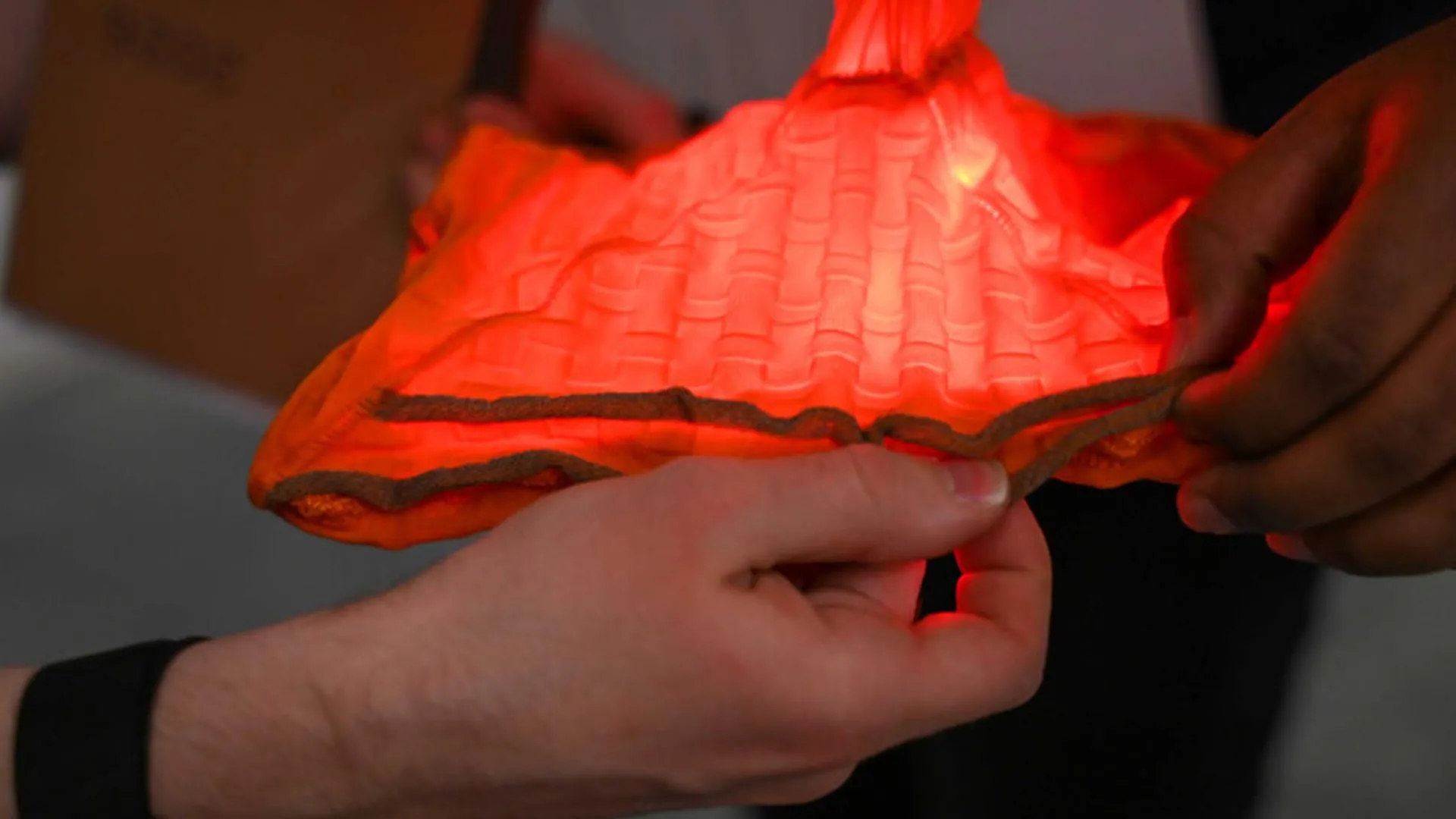
Researchers at Harvard’s John A. Paulson School of Engineering and Applied Sciences have shown that ordinary industrial knitting techniques can produce fabrics that change shape, sense movement, and control electronics. The findings were published in Advanced Functional Materials.
The team used elastic yarns and a process called plating, which positions different yarns on opposite sides of a knitted textile. Combined with carefully selected machine settings, this produced dense fabrics that naturally curve into three-dimensional forms. The researchers then arranged horizontal and vertical stripes in specific patterns to make the material “multistable”—able to snap between multiple configurations and remain in each one.
That behavior resembles a switch that stays in either an on or off position. The researchers studied how the fabric’s geometry and material properties affected its ability to snap between states. They also modeled the textiles as continuous materials, rather than representing every individual yarn, and successfully simulated the observed behavior.
To add electronic functionality, the team incorporated thin conductive yarns. When the knitted structure moved between its stable configurations, its electrical state changed, allowing the fabric to serve as a soft, stretchable switch.
In one demonstration, a knitted shell switched an LED on and off as it changed shape. Another prototype was designed to sit over a knee or elbow. Bending the joint caused the textile to snap, and an Arduino detected that movement to count steps. The researchers also made a reconfigurable lampshade with three separate switches, each controlling a different color of light as parts of the fabric were stretched and moved between configurations.
The work was led by Kausalya Mahadevan, a recent doctoral graduate who is now a postdoctoral associate in Katia Bertoldi’s lab. The project’s machines are similar to industrial knitting equipment used in garment factories, which the researchers say could make the approach potentially scalable. The source material does not report a commercial product or clinical testing.
The researchers frame the textiles as a possible platform for programmable fabrics and connect the work to nonlinear mechanical metamaterials—structures designed to bend, buckle, or snap in controlled ways. Future concepts described by the team include textiles that track body movement, provide tactile feedback, or alter their shape when needed. Those applications remain prospective; the reported demonstrations establish laboratory prototypes rather than proven health or performance benefits.
Reporting Note
Biohack Report distinguishes preliminary findings, clinical evidence and commercial claims whenever the available reporting supports that distinction. Coverage is informational and is not medical advice.